

“I’m not a finder of fact about what happened at that time, because I wasn’t there.”
— Charles “Andy” Morgan, M.D., forensic psychiatrist
This is the second half of my conversation with two forensic psychiatrists: Jeff Rouse, M.D., of the Tulane University School of Medicine, who works in forensic settings across Louisiana, and Charles “Andy” Morgan, M.D., of Yale and the University of New Haven.
It's the seventh part of a series on the Lindsey Clancy mistrial.
Part I: the question the jury couldn’t answer, explained.
Part II: the experts disagree about whether she was psychotic, honestly.
Part III: she got better care than most Americans, and it wasn’t enough.
Part IV: the social contract that allows for great patient care is broken.
Part V: treatment is the easy part.
Part VI: forensic psychiatrists discuss proving a negative.

I’ve got a new book about it.
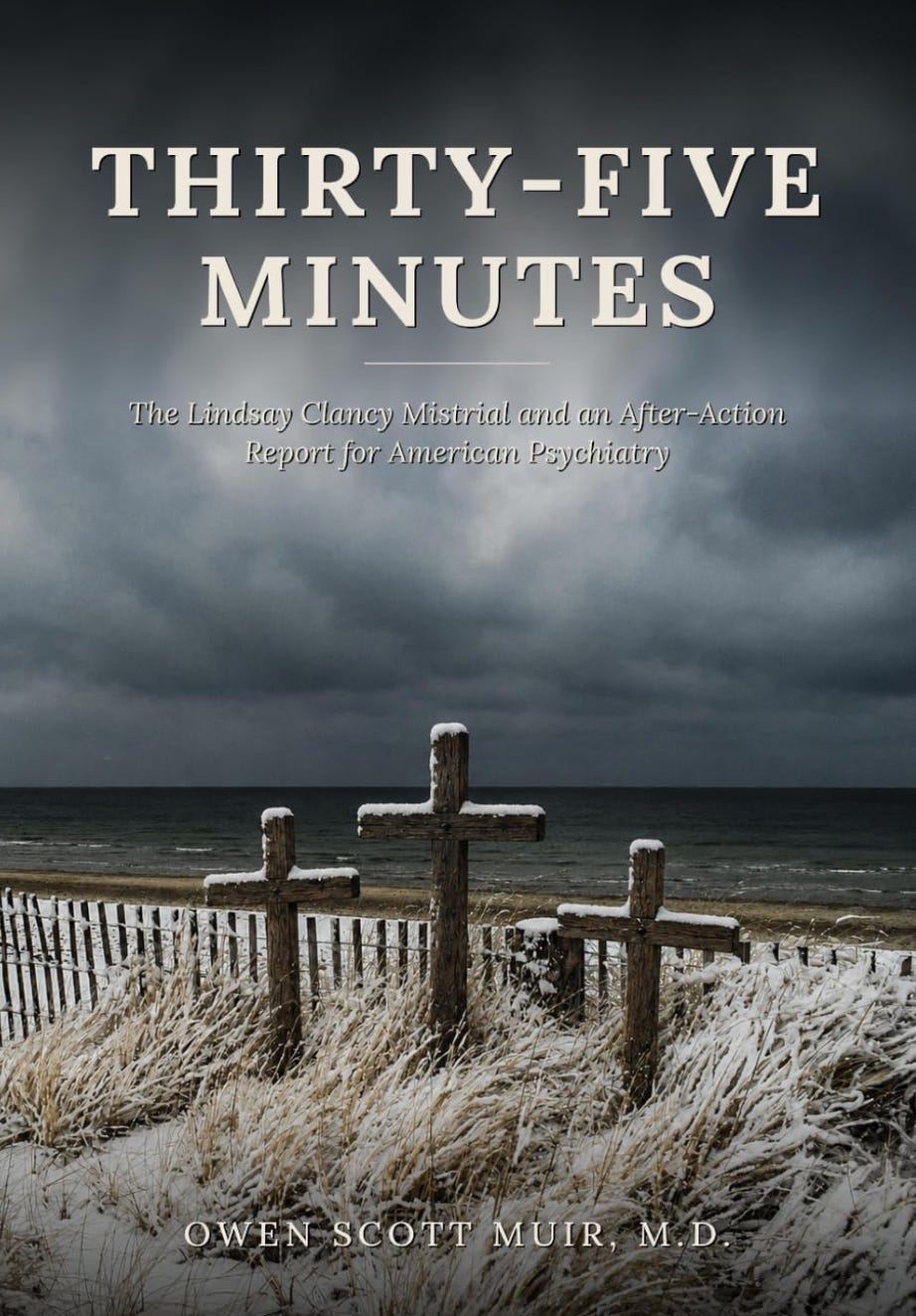
FYI, It’s $0 if you have kindle unlimited. Share it in those group chats of yours!
In Part 6, My guests explained what a forensic evaluation is, to whom the evaluator is responsible, and why Massachusetts requires the Commonwealth to prove, beyond a reasonable doubt, that a defendant was sane—what Jeff Rouse called being asked to “prove the negative.”
The disclosures: Neither has any involvement in Commonwealth v. Clancy. Neither practices in Massachusetts, and both were emphatic about that.
I am the Chief Medical Officer of Neurolief and the Chief Scientific Officer of Radial. I am not a forensic psychiatrist, and I have been an expert witness twice, as disclosed in Part 1.
This time: who calls the doctor, what a jury actually does with an expert, and what happens to a person after a verdict of not criminally responsible.
Who Calls the Doctor, and When
In the first part of my series, my friend Dr. Chris Aiken said of expert witnesses, “they all say what they’re paid to say,” and proposed a central pool so that judges, not lawyers, pick the experts.
At the time, I agreed with him. Here are two forensic experts who describe how their hiring actually occurs, and how they try to avoid the trap Chris outlined.
Both Sides
Owen: You’ve both worked with district attorneys and defense attorneys. Most good forensic experts work on both sides, because that’s the only way you have credibility.
Andy: It depends somewhat on your specialty, whether the other side calls you. But it’s important to work for either side. There are some people who only work for the prosecution, because they pay better.
Owen: I’ve done both, and I can confirm that’s true. When an attorney is thinking of bringing a case, do they consult the psychiatrist before, or only bring us in after?
Jeff: In my experience, the savvier prosecutors and the savvier public defenders have pre-established relationships with experts they’ve used officially in the past, for reports and testimony. Sometimes those relationships get pre-consulted: hey, doc, I’ve got this case, here are the general facts, what do you think is going on? Is this worth taking? I’ve been retained, officially, paid, to help district attorneys decide whether it’s useful to bring charges, or whether to start stipulating to the not-criminally-responsible angle from the outset. Most of the time forensic experts are used on the back end. On occasion we’re consulted on the front end. That comes with a host of ethical issues. One has to be very clear that one is getting only one side of the information. Our ultimate obligation is to the truth rather than to the needs of the attorney.
Owen: The obligation to the truth, Andy.
Andy: In my experience, the good attorneys say: I want your unvarnished opinion. I need to know what kind of case I have. The ones I’d view as less experienced, or more foolish, say: here’s what I want to hear you say on the stand. I usually say: you may end up woefully disappointed once I look at the person and all the data, because I’m the one under oath. Really experienced attorneys say: this is a messy case. Can I sound you out on what kind of case I have, psychiatrically, without committing to retaining you? Personally, I preferred when they called. I’d spend half an hour or an hour on the phone figuring out what kind of case it is and whether I’d even be useful, and I’d just tell them. I don’t want to waste your time or money. What are you looking at, what are you hoping for, what data do we have? I’ve said to some: boy, that’s a long shot. No jury is going to buy it. If you don’t have a track record of mental illness, or something so crazy-looking that they can’t imagine the person doing anything different, they’re just not going to buy it.
