

Dear readers, I suffer from agita. This is only in part because I'm Italian. For the non-Italians in the room, agita is a relatively new word in the English language. It means “anxiety, stress, or agitation.” However its root doesn't come from the same root of the word agitation.
Agita, which first appeared in American English in the mid-late 20th century, comes from a dialectical pronunciation of the Italian word acido, meaning "heartburn" or "acid," from Latin acidus. (Agita is also occasionally used in English with the meaning "heartburn.") For a while the word's usage was limited to New York City and surrounding regions, but the word became more widespread in the mid-1990s.
It's at this point that I remember-1the mid 1990s were, now, a long time ago.
This specific agita that I'm referencing? It's about bipolar depression. Regular readers will be familiar with the fact that the editor and most frequent author here on The Frontier Psychiatrists newsletter, Owen Muir, M.D., has bipolar disorder. For most people with bipolar disorder, most of the time spent sick? It is time spent depressed.
There is a paucity of options with strong evidence for bipolar depression. The most famous medicine for bipolar disorder, lithium (link to Dr. Chris Aiken’s awesome guide), which I still recommend people try as early in the disorder as possible, doesn't treat acute bipolar depression.
The only medicines with FDA labels for the treatment of acute bipolar depression are:
Quetiapine (Seroquel / Seroquel XR) — bipolar I and II depression, monotherapy
Lurasidone (Latuda) — bipolar I depression, monotherapy and adjunct to lithium or valproate
Cariprazine (Vraylar) — bipolar I depression, monotherapy
Lumateperone (Caplyta) — bipolar I and II depression, monotherapy and adjunct to lithium or valproate
Olanzapine–fluoxetine combination (Symbyax) — bipolar I depression
And electroconvulsive therapy’s class II clearance includes acute bipolar depression in the language. Prevention of depressive relapse adds lamotrigine as one more option.
I'm gonna speed run the problem with the above acute drugs: they're all atypical antipsychotics, and that means weight gain, that means akathisia, that means Tardive Dyskinesia. They also just don't work for everybody. As someone has personally put up with every one of those side effects, I can tell you, with all the honesty that anyone could muster, the side effects are miserable.
We can go back-and-forth on the number needed-to-harm and relative risk of those medication's if we really wanted to, but I don't want to. I want to talk about something new that doesn't have any of those risks.
But before I talk about that new thing, I wanna point out that there's a problem. You see how short that list is? Do you see how limited the range of options are? That's actually because of an economic problem. There's a biological problem alongside it, but primarily we are talking about a problem with the market size of bipolar depression.
There are fewer people with bipolar depression than there are with unipolar depression.
That means if you're walking into the door of an investor for your New Thing. And it might help some kind of depression. You're not sure if it's gonna help bipolar depression, or unipolar, depression, or even work equally well in both? You're going to say it works for major depressive disorder a.k.a. unipolar depression, instead of bipolar depression. Because that increases the chance that you'll get the money to go develop The New Thing in the first place.
Here is a quick Claude-assisted graphic of the problem:
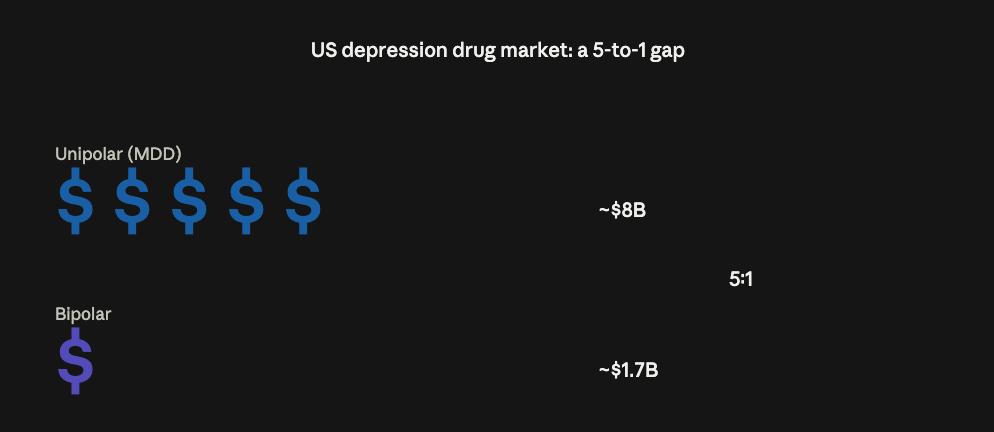
And that $1.7b number? It is an estimate based on all bipolar medicines (including maintenance and mania indications) not just a bipolar depression indication. The ration of the market size is 5:1, and so it’s slightly daft to go try to raise money for a smaller problem which also has the risk of bipolar therapeutic development.
We talk routinely about the unmet need of patients with depression. But not every FDA-labeled treatment for major depressive disorder causes obesity, movement disorders, and more. Bipolar patient's face even more pressure, and understandably, so, to continue taking medication, because the cost of relapse can be a life ruined.
If you don't believe me, just ask Kanye.1
Bipolar depression is more of an unmeetable need, at least in Pharma and med device—because between two pitches, the founder who promises to go after a market 5x bigger wins, all things being equal.
There's another problem—bipolar depression trials are less likely to show a difference between active agent and placebo. About half of clinical trial programs for unipolar depression drugs submitted to FDA fail. In Bipolar depression, the drug-placebo gap is smaller (roughly 55% vs 39% response)2. High Placebo response regularly erases it this difference—remember, the natural history of bipolar depression is to get better pretty quickly, and most drugs work relatively slowly, and so the natural history of the illness, including spontaneous remission, is often working more quickly than any drug could hope to work.
Return returning to my earlier point about raising money to solve the problem? Ardent founders would have to pitch “smaller market, and…wait for it…higher risk!”
That's bad math for fundraising, and so we see, essentially, a raft of me-too drugs to address this crucial problem. These options are not enough. I've previously written about the promise of accelerated transcranial magnetic stimulation, particularly the SNT approach, in bipolar depression. It does look like that's likely to work—but somebody has to do a large enough trial, submitted to the FDA, to change the label, and that just starts the conversation with payers about coverage.
Today we have more data, that's hopeful, but unlikely to lead to meaningful coverage, because the academic researchers chose to study something. I bring you: IV ketamine. For bipolar depression.
The authors of the KET-BD study included the following participants:
The Ket-BD study (Ketamine for Treatment-Resistant Bipolar Disorder) was an investigator-led, double-blind, midazolam-controlled randomized clinical trial conducted at 3 sites in Ontario, Canada, from July 2022 to November 2025. Participants included adult outpatients (aged 21-65 years) with a primary bipolar I or II disorder DSM-5 diagnosis with a current moderate to severe major depressive episode ([MADRS] score ≥21), having had at least 2 failed trials of evidence-based pharmacotherapies.
The subject were randomized to:
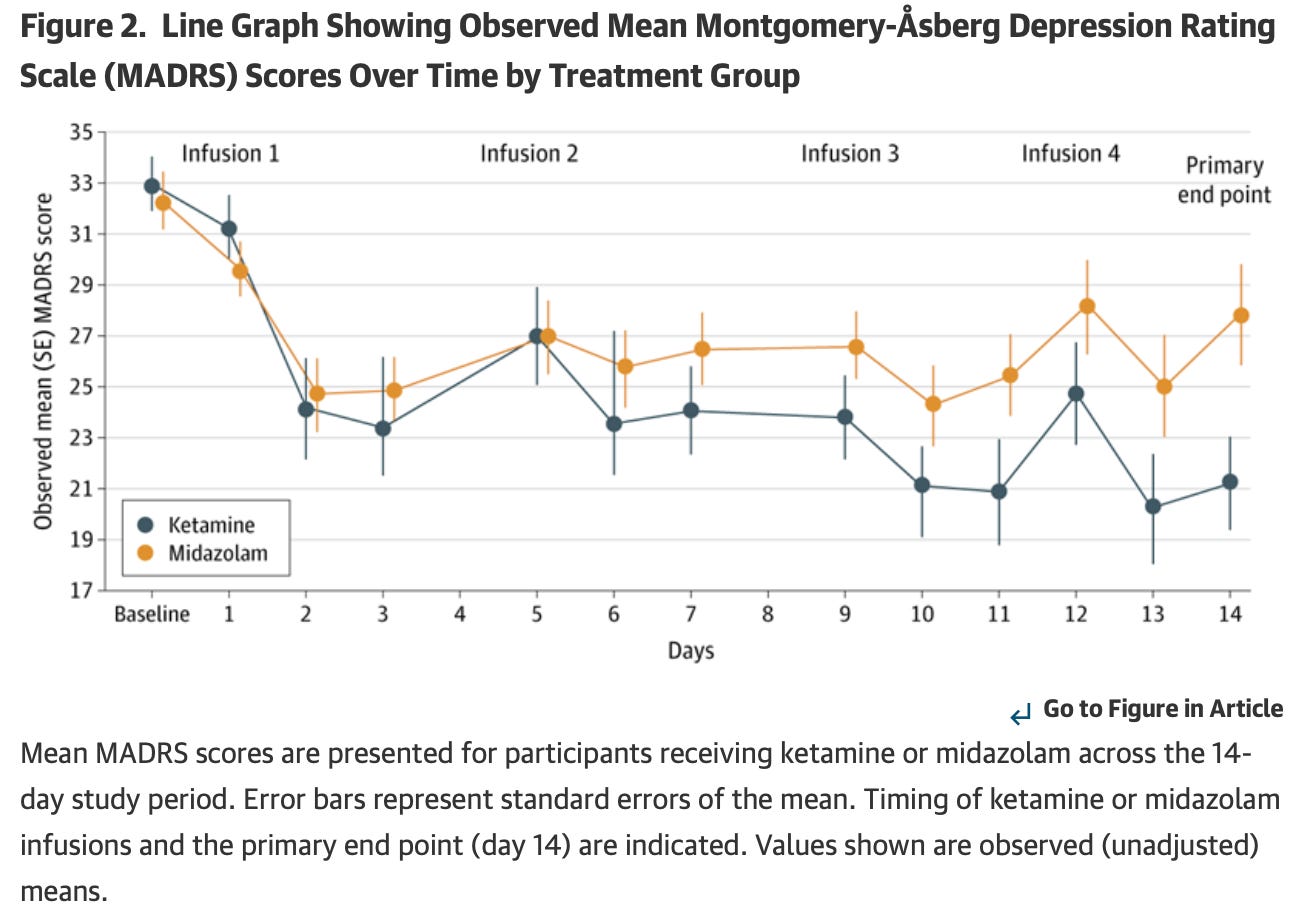
four 40-minute infusions of 0.5 to 0.75 mg/kg of ketamine or 0.02 to 0.03 mg/kg of midazolam, adjunctive to a stable dose of at least one antipsychotic or mood stabilizer, over 2 weeks.
There were more dropouts in the placebo group:
Of the participants, five — one of whom was assigned to ketamine — withdrew before the study’s primary endpoint.
Which to me speaks to the lack of integrity of IV midazolam as a blind, but the data on dose #1 didn’t support unblinding at that time point:
47% of participants correctly guessed the treatment allocation after the first ketamine infusion “despite the ketamine arm having greater dissociation during infusions.”
And the treatment worked:
The researchers reported that the mean MADRS score at 14 days was significantly lower in the ketamine group vs. the midazolam group (between-group difference = –7.3 points; 95% CI, –12 to 2.5).
The split between bipolar I and bipolar II (my usual “did the Study just enroll people with depression who wanted to get ketamine by pretending to have bipolar mania disorder in the distant past?” BS filter) was not completely unreasonable. It looks like they enrolled sick people.

My colleague Nico Grundmann, at Ember Health, assures me that this is a routine part of their care, and that it works well. Here's another piece of data suggesting that that's the case. There's no FDA labeled treatment for acute relief of bipolar depression. There needs to be.
Dear Pharma companies, let's do this. Patients with bipolar disorder, like myself, need access to more treatments. Ideally those treatments will work quickly.
I feel pretty terrible that even as a Psychiatrist— and as clinical trial principal investigator— I have done precious little, personally, to advance the well-being of people who have the bipolar disorder that I am also living my way through. I feel guilty that I'm lucky enough to be able to get off-label treatments like transcranial magnetic stimulation and ketamine because, even though I'm not wealthy, I was able to scrape together the money. Most people aren't that kind of lucky. Most people don't even know if it would be worth their hard earned dollars or those of their family. I'm luckier than most. I haven't done enough, personally, to make it better for people like me. If this article reaches one person who gets to make the decision on which company to cut a check into next, and it's one that wants to make a big dent in bipolar disorder, feel free to call me, and I'll tell you it's a good idea. This will be less true financially than it will be emotionally, but I'm OK with that. Investing in the lives of people with bipolar disorder is the right choice.
A brief note, to my readers, I keep most of these free. I don't get upset if you want to subscribe though. It helps support the mission. It proves to people who invest substantial amounts of money in this field of a human endeavor that my ideas have traction. Please consider subscribing.
This is the full text of his public apology letter. It is here to drive home the point that bipolar disorder, and it’s mania, and be destructive at a scale it is hard to imagine for most of humans.
To Those I’ve Hurt:
Twenty-five years ago, I was in a car accident that broke my jaw and caused injury to the right frontal lobe of my brain. At the time, the focus was on the visible damage—the fracture, the swelling, and the immediate physical trauma. The deeper injury, the one inside my skull, went unnoticed.
Comprehensive scans were not done, neurological exams were limited, and the possibility of a frontal-lobe injury was never raised. It wasn’t properly diagnosed until 2023. That medical oversight caused serious damage to my mental health and led to my bipolar type-1 diagnosis.
Bipolar disorder comes with its own defense system. Denial. When you’re manic, you don’t think you’re sick. You think everyone else is overreacting. You feel like you’re seeing the world more clearly than ever, when in reality you’re losing your grip entirely.
Once people label you as “crazy,” you feel as if you cannot contribute anything meaningful to the world. It’s easy for people to joke and laugh it off when in fact this is a very serious debilitating disease you can die from. According to the World Health Organization and Cambridge University, people with bipolar disorder have a life expectancy that is shortened by ten to fifteen years on average, and a 2x-3x higher all-cause mortality rate than the general population. This is on par with severe heart disease, type 1 diabetes, HIV, and cancer - all lethal and fatal if left untreated.
The scariest thing about this disorder is how persuasive it is when it tells you: You don’t need help. It makes you blind, but convinced you have insight. You feel powerful, certain, unstoppable.
I lost touch with reality. Things got worse the longer I ignored the problem. I said and did things I deeply regret. Some of the people I love the most, I treated the worst. You endured fear, confusion, humiliation, and the exhaustion of trying to have someone who was, at times, unrecognizable. Looking back, I became detached from my true self.
In that fractured state, I gravitated toward the most destructive symbol I could find, the swastika, and even sold T-shirts bearing it. One of the difficult aspects of having bipolar type-1 are the disconnected moments - many of which I still cannot recall - that led to poor judgment and reckless behavior that oftentimes feels like an out-of-body-experience. I regret and am deeply mortified by my actions in that state, and am committed to accountability, treatment, and meaningful change. It does not excuse what I did though. I am not a Nazi or an antisemite. I love Jewish people.
To the black community - which held me down through all of the highs and lows and the darkest of times. The black community is, unquestionably, the foundation of who I am. I am so sorry to have let you down. I love us.
In early 2025, I fell into a four-month long manic episode of psychotic, paranoid and impulsive behavior that destroyed my life. As the situation became increasingly unsustainable, there were times I didn’t want to be here anymore.
Having bipolar disorder is notable state of constant mental illness. When you go into a manic episode, you are ill at that point. When you are not in an episode, you are completely ‘normal’. And that’s when the wreckage from the illness hits the hardest. Hitting rock bottom a few months ago, my wife encouraged me to finally get help.
I have found comfort in Reddit forums of all places. Different people speak of being in manic or depressive episodes of a similar nature. I read their stories and realized that I was not alone. It’s not just me who ruins their entire life once a year despite taking meds every day and being told by the so-called best doctors in the world that I am not bipolar, but merely experiencing “symptoms of autism.”
My words as a leader in my community have global impact and influence. In my mania, I lost complete sight of that.
As I find my new baseline and new center through an effective regime of medication, therapy, exercise, and clean living, I have newfound, much-needed clarity. I am pouring my energy into positive, meaningful art: music, clothing, design, and other new ideas to help the world.
I’m not asking for sympathy, or a free pass, though I aspire to earn your forgiveness. I write today simply to ask for your patience and understanding as I find my way home.
With love,
Ye
Iovieno N, Nierenberg AA, Parkin SR, Hyung Kim DJ, Walker RS, Fava M, Papakostas GI. Relationship between placebo response rate and clinical trial outcome in bipolar depression. J Psychiatr Res. 2016 Mar;74:38-44. doi: 10.1016/j.jpsychires.2015.12.016. Epub 2015 Dec 20. PMID: 26736040.
Hi... I'm not trying to be difficult here, these are genuine questions that come to mind when I read this blog.
The improvement in MADRS score... The confidence interval crosses 1, so as I understand it, it's plausible that ketamine could actually make their mood worse??? And given the minimum clinically significant difference in the MADRS is as much as 5 points, 7 points suggests it is not having much of an effect for most people. But my biggest issue is the CI crossing 1: I've learnt that this is synonymous with the difference not being statistically significant. Yet you don't acknowledge this?
You also claimed that the natural history of bipolar depression was that people improved too quickly for meds to make a noticeable difference in studies (not my experience LoL)... My logical response to that, is that in that case, why bother treating it? If it resolves quickly by itself??? Genuine question; my conclusion from that is that we really don't need to treat something that self resolves before our meds can have an effect.
I can't remember exactly how you described the side effects of antipsychotics... Something along the lines of they made people's lives miserable. But it struck me as hyperbolic. As someone who has taken them for 15 years, they've transformed my life from not worth living, to a high functioning individual with a meaningful life who hasn't had a mood episode for getting closer to ten years. Sure I acknowledge metabolic syndrome is likely to shorten my life, but I have zero symptoms, and I'm not invested in quantity of life... I'll take quality over quantity every day, and my aim is to die younger anyway (the longer I live, the more likely I'll get dementia - my next worse case scenario after intractable mental illness). (Yeah sure I've experienced akathisia, but I've had more severe side effects from lithium, which I understand you advocate?)
It may interest you to know that veterans can get publically funded IV ketamine therapy here in Australia; it's not available in the public health system, is available privately in some places but not at the local private psych hospital.