

I’ve previously lamented about my, and our field’s, lack of progress in bipolar depression. A new paper gave me some hope, so I sat down with its senior author and had a chat about it. As a disclosure, I’m also an advisor to Ampa Health, the study sponsor, which Dr. Downar is a founder of, as well. This article is pretty science heavy, and so it’s really intended for my fellow clinicians. For general audience members who want to understand how we think, enjoy following along!
Owen Muir: Introduce yourself for the audience, if you could.
Jonathan Downar: Hi, it’s Jonathan Downar. I’m a physician-scientist, appointed academically at the University of Toronto Institute of Medical Science and the Department of Psychiatry, and also the co-founder of Ampa Health.
Owen Muir: We’ve talked before about bipolar disorder. Can you lay out a little background on why it matters? What’s the problem in bipolar disorder for most people, and why does it matter to treat, compared to what we have currently?
Jonathan Downar: Sure, and I obviously can’t speak with any more authority on this than you would. But it’s worth everybody understanding that bipolar disorder is reasonably common, and that although what people think about is mania and hypomania, the problem most of the time, for most people, is the depressive phases. They go on for long periods. They don’t always respond the way we’d expect to medications or therapy. So we need new treatments to help folks going through periods of depression in bipolar disorder.
Owen Muir: I’m going to draw it out a little more, in my role as someone with bipolar disorder.
Jonathan Downar: I felt a little off saying this to you. You’re the one who has both the expertise and the lived experience.
Owen Muir: You’re allowed. Maybe I’ll speak from my mom’s perspective, when she realized she had a kid with bipolar disorder.
We have limited options for bipolar depression. We have lamotrigine for prevention of relapse, because you can’t titrate the drug up safely enough, fast enough, to prove anything else. We have a couple of other agents, Seroquel, Caplyta, cariprazine (Vraylar), and lurasidone, all of which are atypical antipsychotics. It’s nice that they work, but it’s not great that many of them carry meaningful risk for metabolic syndrome and, of course, tardive dyskinesia. We have lithium, which doesn’t prevent depression in bipolar disorder but does reduce the risk of subsequent episodes, which is great if you can tolerate it. We have Depakote, which in theory prevents mania but, again, doesn’t prevent bipolar depression.
So we have this illness defined by two mood states. Depression, which is most of the time: 50 percent or more of the time spent sick is spent depressed. And then mania, which for many people with milder bipolar disorder isn’t the real problem in their life, but it lets us know what the problem is: this is bipolar depression that doesn’t respond to traditional, quote-unquote, antidepressants, compared to unipolar depression, which responds some of the time.
But there’s another problem, which is the time course of the illness. I’ve thought a lot about this in the past couple of years. Bipolar depression gets better more quickly than unipolar depression. I think you’d agree. It tends to go on less long.
Jonathan Downar: Yes. Certainly when we’ve done TMS, that’s what we see: bipolar I depression seems to get better quicker than unipolar, and bipolar II seems to be about the same.
Owen Muir: Not to muckrake here. You’re a psychiatrist, not necessarily a bipolar expert per se, but you’ve treated a lot of patients. Does bipolar II need to exist?
Jonathan Downar: It’s an interesting question. I would find that the same patients in the psychopharmacology clinic would be diagnosed as bipolar II, because that unlocked a wider variety of tools. And when they came down to the TMS clinics, where bipolar isn’t always funded for TMS, the very same patients would often be considered major depression with cluster B features, or major depression with mood instability, because that would unlock the possibility of TMS. So whether bipolar II is its own entity, or reflects a general mood instability with a predisposition toward depression, is a super interesting side conversation.
Owen Muir: We won’t get deep into it now.
Jonathan Downar: No. But there is certainly this other thing called bipolar I, where people go into full-blown manic episodes, with behavior clearly recognizable to anybody outside as not within the scope of standard behavior, and where people get into real problems. Episodes that can be very destructive to a person’s life and relationships. When I was a psychiatry resident, there was a person who went into a manic episode during residency and managed to recruit other residents into an investment scheme, and all kinds of other strange things happened. It can be really disruptive to relationships and to life in general.
Owen Muir: It’s a bummer when good “deal flow” is ruined by a mood disorder.
Jonathan Downar: [laughs]
Owen Muir: Bipolar disorder is a funny thing, because it gets injected into popular parlance, “oh, that’s so bipolar,” as the kids like to say, but it really can be tremendously disabling at the zenith of its severity, and mildly disabling at other times. Which doesn’t make it fun. It just makes it easier to make fun of. Or take less seriously.
Jonathan Downar: Right. And as with all of these things, how do I say this properly? Part of overcoming stigma is education and compassion, and another part is just having effective treatments that work rapidly. The example I’ll give: I knew a resident during my training who had gone through bipolar disorder, eventually gone through treatment, and overcome the manic and depressive episodes. The program fought tooth and nail not to let him back in. They were really worried about what he would do with patients. This was decades ago, but there remained, among psychiatrists, a stigma toward this fellow practitioner who now had bipolar disorder, and people were worried it may not be a great idea for him to continue in his profession.
So overcoming stigma is about more than knowledge and understanding and compassion. If there were strong, effective, safe treatments that worked well and worked rapidly, then all of a sudden conversations like that might be less common.
Owen Muir: The futility of our treatment circumscribes our ability to suspend our stigmatized beliefs.
Jonathan Downar: I think that’s it. One individual I spoke to about this took the position: look, I have all the compassion in the world, I understand this is a biological thing and not a moral failing, but if this person is going to be on disability for six months a year, how am I supposed to keep them in my program? How am I going to compensate for that? Weirdly, you still get conversations like that. And they’re conversations that don’t have to happen if we have treatments that work.
Owen Muir: For you to know, the reason I first got TMS is that at least the promise was there that it would resolve my depressive symptoms in a timeframe that would allow me to graduate on time. I had been out on medical leave from a prior depressive episode earlier in residency, and I had seven sick days left. There’s a minimum number of days you have to complete to be a resident who completed residency, and I wasn’t going to get to fellowship if I didn’t complete those days, because I didn’t have enough sick or vacation days to do it. So I got TMS so I could graduate on time. And luckily it worked.
Jonathan Downar: Thank you for sharing that with me. I knew you’d shared part of the story, but not all of it until now.
Owen Muir: I saw a remarkable TMS doctor, now retired, named Robert McMullen. A deeply decent man who was willing to take a swing and actually treated me with two sessions a day, because he was familiar with some of that early research. So the first course I got was sort of accelerated.
So walk us into this ONE-BD paper. What did you do, in what time frame, for people with bipolar disorder?
Jonathan Downar: That’s a good lead-in. TMS has been getting more and more evidence for unipolar depression. In the original versions, it’s a once-daily treatment, 24 hours between sessions. Then people realized it might be closer to 24 minutes between sessions, that they can be a lot closer together. So people started trying once daily, twice daily, three times, five times, all the way up to ten times daily. About a year ago, we published our ONE-D study in unipolar depression, which delivered 20 sessions in a day, and showed the results could be quite strong if the person was on a medication to augment the effects of TMS.
Owen Muir: The medication you’re talking about was not an antidepressant, to be clear.
Jonathan Downar: That’s right. If you go back to the early literature on D-cycloserine, from around 1959, I think there are a couple of studies suggesting it’s an antidepressant. But its on-label indication is typically second-line anti-tuberculosis. It’s an antimicrobial agent that happens to be a partial NMDA receptor agonist. TMS works by enhancing plasticity, strengthening the connections between neurons, and that also relies on the NMDA receptor. A researcher named Alexander McGirr at the University of Calgary figured out that if you combine the two in unipolar depression, 20 sessions can achieve a much higher remission rate than it normally would.
Owen Muir: Just to check in: if I remember correctly, that McGirr paper showed a 0.99 effect size for augmentation of intermittent theta burst plus DCS versus iTBS alone.
Jonathan Downar: That’s exactly right. If you look over the entire 30 years of TMS literature, a nice rule of thumb is that the remission rate is roughly the same as the number of sessions. In the early days, when they only did 10 or 15 sessions, the remission rate in the big meta-analyses was usually around 13 percent, for an average of 12.9 sessions. Later studies went up to 30 sessions, and all the naturalistic studies seem to show about a 30 percent remission rate for 30 sessions, and so on. The only person to bend that curve was Alex McGirr. He gave a 20-session course, and without DCS the remission rate was just under 20 percent, about what you’d expect. With DCS for just the first 10 of 20 sessions, remission doubled to almost 40 percent. In a follow-up study where he gave it for all 20 sessions, a small study, he reported remission rates closer to 75 percent. We can debate how big it is, but it’s not a small effect. And in OCD it seems even larger.
So the question is: would this strategy of doing lots of sessions in a single day, with D-cycloserine to augment the effects, be useful in bipolar depression the same way it appears to be useful in unipolar depression, and the same way Alex’s work suggests it could be useful in OCD?
Owen Muir: And this data set was from the OBSERVER data set, where you’re collecting data on people getting treatment with the Ampa device. Can you walk us through what stimulations were included in this analysis?
Jonathan Downar: That’s right. Let me do a quick background on the literature first. People have been studying TMS for bipolar disorder for decades, folks like Jeff Daskalakis, Paul Fitzgerald, Yvette Sheline, and others. There are several early positive studies with once-daily treatment, and even meta-analyses that support it. There have been other studies, interestingly including by Alex McGirr, that were not able to separate from sham. And then a more recent study by Yvette Sheline and Robin Cash used a precision MRI-guided approach to fine-tune the target, mostly in folks with bipolar II, and with a five-day course of ten sessions a day, reported a remission rate close to 70 percent. Quite powerful.
So the two trends are: many studies showed good effects and some showed inconsistent effects, and then there’s this recent trend toward accelerated treatments. That’s the context we’re coming into.
One thing we had to decide was where to put the coil. The standard target in depression is the left dorsolateral prefrontal cortex. That’s by far where most of the papers have gone, and I think it was for that target that the results have been somewhat inconsistent. Another emerging target is the dorsomedial prefrontal cortex. If you stimulate the dorsomedial prefrontal cortex in people who are not depressed, they get measurably better at impulse control on decision-making tasks. And having stimulated that area since about 2011, what we saw consistently was that people tended to improve their ability to self-regulate their emotional states, their thoughts, and their behaviors.
Owen Muir: Just to check my understanding: Shan Siddiqi has talked about the anxious-somatic circuit. This would overlap with that. BrainsWay has the H7 coil. This is, again, the middle of the head.
Jonathan Downar: Yes. MagVenture has the DB80 coil, Ampa has the M coil, and so on. There are various coils that can target this medial area rather than the lateral area. We published a paper back in 2015 looking at about 180 people who received dorsomedial stimulation, and we found equally good effects in unipolar and bipolar depression using this target. So when it came our turn to try a one-day version of TMS for bipolar, we decided to steer away from the inconsistent results associated with dorsolateral stimulation and go toward the dorsomedial target. That’s the main design choice I want to emphasize: we’re not doing regular dorsolateral stimulation.
Owen Muir: I want to check here, because this is lighting up something in my brain in real time. For years we’ve been trying studies in bipolar depression using overwhelmingly dorsolateral stimulation, because that’s what we used in MDD, and getting inconsistent results. The BrainsWay H1 coil didn’t pan out. Left DLPFC targets show lower remission rates than in unipolar depression in real-world studies, and the randomized controlled trials have largely failed to do the trick. Maybe, as is the case with all the oral antidepressants, which don’t work in bipolar, bipolar depression is different. Maybe it needs a different circuit, on average. Is that a fair assumption behind this?
Jonathan Downar: It’s a possibility. When we look at what these networks do in the wild, the dorsomedial prefrontal cortex plays an important role in self-directed control of thoughts, behaviors, and emotions. The brain always has two pathways. There’s a pathway for exogenously controlled behavior: when the traffic light turns green, you press the pedal and go forward. But there’s a whole separate set of pathways for when the signals have to come from within you. Those tend to live more on the medial prefrontal cortex than the lateral. So that’s where we go when we’re looking to boost people’s ability to self-regulate emotions.
We had previously done a sham-controlled crossover trial in borderline personality disorder and found dorsomedial stimulation worked very nicely; people were much better able to regulate their emotions. I don’t want to draw too many parallels between the two, but if we’re generally trying to provide people with mood stability, then to our thinking, dorsomedial seemed like a reasonable bet. So that’s what we elected to do in this one-day trial.
Owen Muir: I’m guessing the reason I’m not an author on this paper is that I was thinking of my bipolar subject in the data set, and I realized we didn’t use just that target. So I’m legitimately not an author on the paper.
Jonathan Downar: We’ll correct that next time around, when it’s time to do the big multi-site. You and I have talked several times about the importance of doing this.
Owen Muir: I’m only razzing you. I don’t want to bias my readers too much, because I know my personal experience can be biasing, but for you to know, the treatment that ended up working best for me was the BrainsWay H7 coil, four centimeters anterior to the foot motor hotspot.
Jonathan Downar: Which is almost exactly the same field map as what we would do with the dorsomedial coil. That’s really interesting. It’s not exactly, but it’s very close to what we did.
Owen Muir: So lay out the rest of the study for me. You targeted, I’m guessing, with the M coil, the medial coil.
Jonathan Downar: That’s right. The Ampa system has two coils: the L coil, optimized for lateral convexity stimulation, and the M coil, designed to go deep for medial targets. The field geometry, according to simulations, is pretty similar to the H7. The coil is placed over the Fz location, a standard EEG location, just a little more anterior to the point you mentioned. The stimulation was just three minutes of theta burst, very similar to what we used in the ONE-D study, delivered every 20 minutes.
We were a little bit greedy at that time. We were thinking we might be able to squish all the sessions 20 minutes apart, because clinics certainly like to see if they can get all the sessions done in eight hours. The conservative choice is to go for 60 minutes, or maybe 30 if you’re feeling bold, but 20 minutes is quite tight. There is a refractory period. If you get the sessions too close together, they start to blur together and maybe don’t exert as much of an effect. We were still figuring this out. We wanted this to be as useful to as many people as possible, so we used a 20-minute interval, because if it worked out well, there’d be the added attraction that clinics could deliver this within a single eight-hour shift.
Owen Muir: I’ve had similar academic disagreements with my dear friend Aaron Tendler, where he’s pushed me to do something more scalable, like the SWIFT trial having only five sessions in a day, which I actually disagreed with. I said, there were ten in SAINT, so why don’t we just do ten, because we know ten works? And he said, yeah, but if five works out, it’s better. So here you chose a 20-minute interval. How many subjects were in this paper?
Jonathan Downar: We had 30 people in the study, and we were very insistent that every single one of them have bipolar I depression rather than bipolar II.
Owen Muir: Oh, wow. And why does that matter in interpreting the results?
Jonathan Downar: To the point you raised earlier, there’s some disagreement as to whether the thing we’re treating in bipolar II is quite the same as the thing we’re treating in bipolar I. So we wanted it to be 100 percent clear that all the folks here had had full-blown manic episodes and met DSM criteria for bipolar I. That was their diagnosis.
We went to a clinic, Salience Health in Dallas, that offered to do the work. They have thousands of patients, and quite a lot of them were in the unfortunate situation of having depression, but bipolar I depression, so they’d been denied for TMS. When the opportunity came up, I think they had about 150 people in that situation who could come in and try this.
Owen Muir: There is no faster-enrolling study than the an open-label trial for a treatment insurance does not authorize.
Jonathan Downar: Exactly. Sometimes I’ve seen people fight the good fight and argue and get coverage, but it’s always a battle. This is the first step toward making it less of a battle.
Owen Muir: In fairness to our payer colleagues, they need some data that says this actually works before they can cover it.
Jonathan Downar: That’s it. There are some very encouraging studies, and a couple that found no difference using dorsolateral. So what we’re saying is, let’s reboot this. Let’s use the dorsomedial prefrontal cortex, which may be a better fit for bipolar I depression.
And to finish off the one-day protocol: the key to making 20 sessions do enough work to be useful is that you have to augment plasticity somehow. Twenty sessions of TMS is not typically enough for very many people. About a fifth of people are fast responders who can get to remission on 20 sessions, but most need more. The only way to bend that curve is to augment plasticity, so we used an approach very similar to Alex McGirr’s: 125 milligrams of D-cycloserine from a compounding pharmacy, taken exactly one hour before the sessions commence. During that hour they fill out their baseline scales and have their motor threshold determined, and then they enter their sessions: three minutes of theta burst over the dorsomedial prefrontal cortex with the M coil, every 20 minutes.
Owen Muir: And after doing that, how did you follow these folks up?
Jonathan Downar: One of the interesting things with accelerated TMS is that it often takes a while. Anyone who’s started doing accelerated treatments, compressing all the sessions into five days, or three days, or one, finds the brain often takes a little while to show the full effect. In previous work, we’d done quite a lot of one-day treatments, and if you followed people week by week out to six weeks, their trajectories follow a very characteristic function, an exponential decay. They improve a lot in the first week, but they improve more in the second, and more in the third, fourth, and fifth, until they finally reach a plateau six to twelve weeks out.
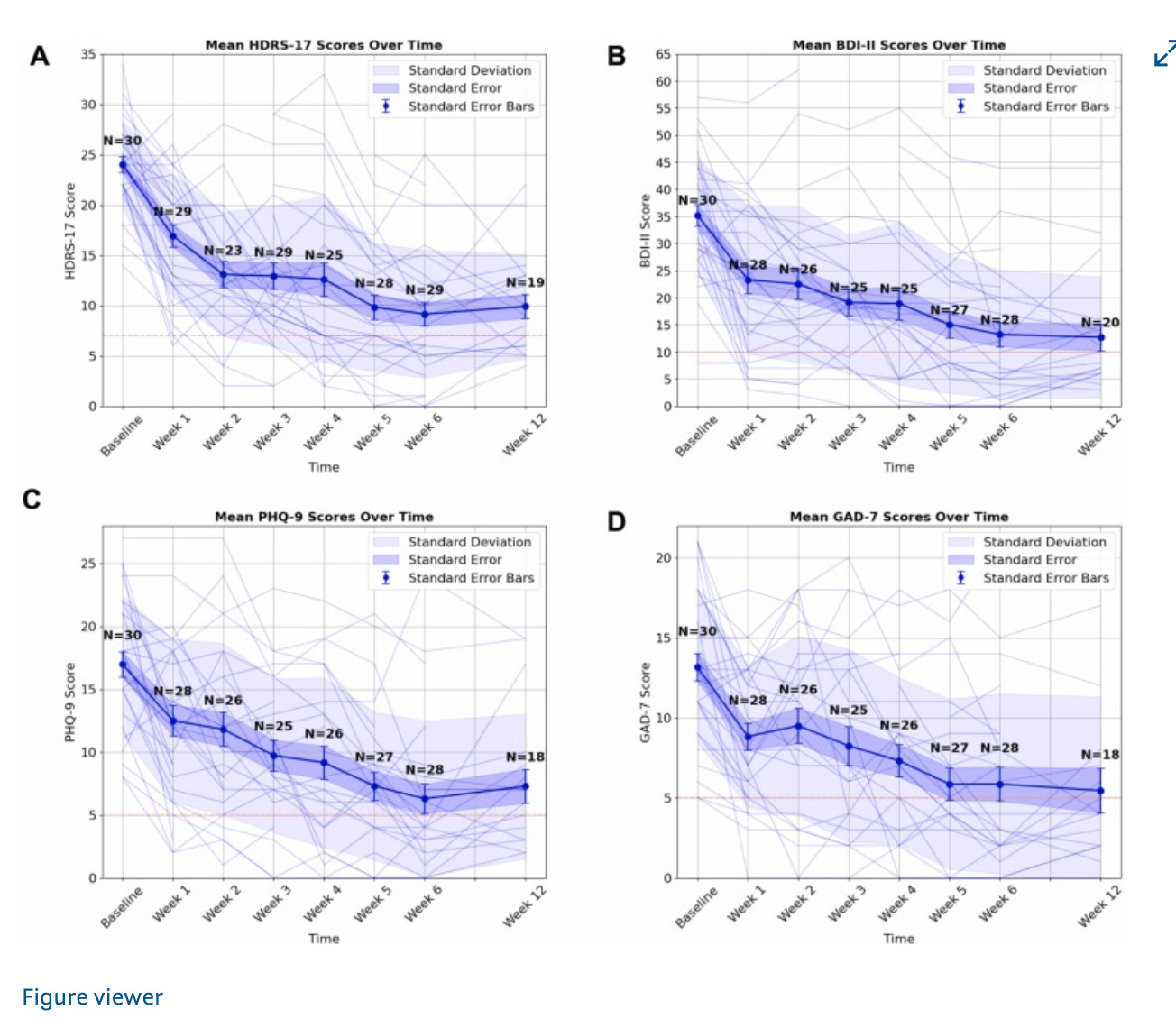
So we followed the same schedule here, and folks gradually improved to a plateau about six weeks out. Now, what was interesting: when we were doing treatments 30 minutes apart, they followed this very nice, smooth exponential curve. With the 20-minute interval, for reasons we still have to unpack, there’s a weird little kink in the curve. They improve, then they seem to get a little worse or plateau, and then they improve a second time. They still end up doing pretty well, but there’s this funny little kink. And the remission rate is not 70 percent. It’s more in the 40 to 45 percent range, depending on which scale you’re looking at.
Owen Muir: Just to clarify for a second. In the CANMAT guidelines I referred to recently, they looked at bipolar depression and whether to recommend TMS. Across all the TMS studies we’ve done in bipolar depression, we’ve seen lower rates of remission. Still, 40-odd percent is way better than any pharmacologic agent we have, but it’s a pretty consistent finding. So the question we’ll have to suss out in subsequent research is: is this lower remission rate something we see in bipolar patients, especially bipolar I, which most prior studies haven’t evaluated specifically? Or is this a problem with the 20-minute intersession interval, which we can only answer by comparing it to another interval?
Jonathan Downar: I think that’s right. Based on 15 years of patients I’ve seen with bipolar I treated with the old once-daily version, you tend to see good results, and you tend to see people responding quickly. And when we’ve tried to treat unipolar depression with these 20-minute intervals, again, we see this funny kink in the data where people don’t respond quite as quickly. You may lose as many as 20 or 30 percent of people for whom 20 minutes is just a little too close together. So I think it will be really interesting to try this again with a slightly longer interval and see if we can boost the outcomes.
The other thing to bear in mind: we just tried to see what you can do for people if all you’ve got is a day. There’s no eleventh commandment that says all sessions must be completed within one day. I’ve had colleagues come to me and say, well, if 20 sessions in one day with DCS is this effective, what would happen if I did a second day, or split it over a few days and gave 30 or 40 sessions on D-cycloserine? These are all perfectly good questions. So I don’t want to give the impression that TMS has a maximum effect of 45 percent remission in this population. It’s an open-label study. What I’m saying is, if you squish all the sessions into a day and follow this recipe, what we saw was about a 45 percent remission rate and a larger number of responders. I think a lot of those responders could become remitters if we slowed down a little and maybe gave them a few more sessions.
Owen Muir: What was the primary outcome measure?
Jonathan Downar: The Hamilton Depression Rating Scale as the clinician-rated scale. We also had self-rated scales: GAD-7, PHQ-9, and the Beck Depression Inventory.
Owen Muir: Did they all follow similar trajectories to the HDRS?
Jonathan Downar: This is one of the interesting things. When you do these one-day open-label trials, you always worry that the people talking to the patients might be overly enthusiastic, so the clinician-rated scales might be too good. Or the patients might be too enthusiastic, so the self-rated scales might be too good. One sanity check is to plot all the scales against one another. To get them on the same measuring tape, you convert them all into percent improvement from baseline. There’s a plot in the paper that shows this: when you plot the self-rated and clinician-rated scales as percent improvement from baseline, they all track very closely.
Owen Muir: So percent improvement looks similar across all the scales.
Jonathan Downar: Exactly. We’re not in a situation where they’re showing 90 percent improvement on the nurse’s rating scale and 10 percent in the patient’s opinion, or vice versa. There’s pretty good agreement between clinicians and patients about how much improvement they’re feeling.
Owen Muir: What does this paper suggest to you are appropriate next steps for research in bipolar depression?
Jonathan Downar: Great question. First, to be clear about what this is: it’s a retrospective case series, not a prospective trial. I’ve been describing it in the terms of a prospective trial, but this was going back through the records of a clinic that is very systematic in how it does things. When they decided to offer one-day treatment, they told the team: make sure you always do the TMS this way, make sure you always collect these scales. We applied to an IRB to do a retrospective chart review, went through, and found 30 patients who had been treated according to the same recipe and followed with the same scales. So we were able to put their data together into a retrospective case series.
Owen Muir: These were the apples that had other apples.
Jonathan Downar: Exactly. Retrospective case series are hypothesis-generating. They’re not even quite at the level of phase one prospective trials. Many people would argue the next step is a prospective phase one trial, and in future a prospective randomized trial with a sham control. To demonstrate efficacy, you do end up having to do a trial against sham. So the future is people, having learned a bit from these retrospective studies, sitting down and designing a proper prospective trial, open-label or sham-controlled, and seeing if there’s a signal there. The endpoint would at some point be going to the FDA for a Q-Sub to get their input on the design of a pivotal trial. If we can find a funding source, it would be great to do a pivotal trial with enough patients for a sham-controlled trial, just as has been done for depression and OCD and other TMS indications, and show that this works in bipolar depression. With that, we’d end up with a really nice new option for people.
Owen Muir: So if there are any people with substantial funds at their disposal looking for a hypothesis to test, one could test whether one day of accelerated TMS to the dorsomedial prefrontal cortex, for example with the Ampa system, would be an appropriate treatment for bipolar depression in bipolar type I. Is that a good summary?
Jonathan Downar: That’s exactly right. There are certainly individuals and organizations with an interest in supporting further work on bipolar disorder, and the ultimate goal of that work is new treatments. We’ve got something here that looks really promising. TMS has been around for a long time. We know it’s safe, we know it’s well tolerated, and these are outcomes that look really strong compared to the medications we currently have.
The other thing you want to look at is scalability. Are we going to develop a treatment so complicated to set up that hardly anybody actually gets it, or is this something that could be delivered all over the place? We’ve been asked, why all this focus on the one-day treatment? The answer is 100 percent about access. There are plenty of counties, and plenty of countries, where there’s no psychiatrist and no TMS clinic within a two-hour drive. So the idea of coming in for 36 days is a non-starter. Even coming in for five or six days is going to be challenging. People have to take time off work, book a hotel. It’s prohibitive for some. But if it’s a day, people in rural areas can come into a center for one day of something. It’s fairly common in medicine that if you have some medical condition, you come in for an all-day procedure.
Owen Muir: Just to check: it’s not so much one day, it’s one drive.
Jonathan Downar: That’s exactly right. It’s a single visit. What is the most we can do with a single visit, and is that enough to be useful for people who really are not living near a clinic? I hope there’s a future where there are TMS devices and effective treatments on every street corner and in every pharmacy. But until we reach that day, TMS clinics are still pretty few and far between, and there are a lot of people who live really far away. Showing that you can get a reasonable success rate from a single-day treatment is just very helpful for access, whether people are in a public system or a private system.
Owen Muir: I’ve had people tell me it’s a life-or-death decision to have a one-day treatment, because they weren’t going to do it if it was anything more than that.
Jonathan Downar: It’s funny. I don’t know what your take is on this, but when we were discussing whether it should be two days or three days, in many people’s minds there’s one day, and then there’s everything else. To tee up your life to come in for one day of something is pretty doable. The minute it becomes two or three days, whether psychologically or logistically, it’s now an overnight hotel stay and so on, and it starts to get complicated.
I don’t think it has to be one-size-fits-all. If you live across the street from a TMS clinic, by all means split it up over several days; you might find it easier to come in after work for an hour. But for the majority of people who live pretty far from TMS clinics, this should at least be an option. I’d like to be able to give people numbers and say: if all you’ve got is a day, here’s what the clinic can do for you.
Owen Muir: Thank you so much.
I loved reading this, great discussion! We've worked quite a bit with Dr. Downar, setting up our Ampa machine, and each time, I find him uniquely skilled at sharing his findings in digestible, wise, and interesting ways.
Between this and the JAMA psychiatry study earlier this month, there is a lot of interesting new literature regarding treating Bipolar I. As a ketamine and TMS clinic, it's very exciting and promising to see the conversation advance.
Looking forward to more!
Thank you for this. As someone living with bipolar depression, it's rare to see a conversation that treats the depressive side of the illness as the main problem, since that's where most of my time is spent. The point about stigma and treatments that work quickly really resonated. I'm hopeful about this research, and I'd love to see it tested in a randomized trial.