Can MDMA-AT Be Saved?: Part I
"This is Why We Can't Have Nice Things"
Welcome to The Frontier Psychiatrists. The FDA held an advisory committee meeting aired on YouTube (link here), and it included the study sponsor (Lykos Theraputics, formerly MAPS PBC) presenting the data from their clinical trials. I know and respect some of the more recently hired folks at Lykos, and they were a sponsor for our Rapid Acting Mental Health Treatment (RAMHT) event here in NYC just a few weeks back.
The coverage of yesterday’s advisory committee hearing by Psychedelic Alpha was, by the way, awesome.
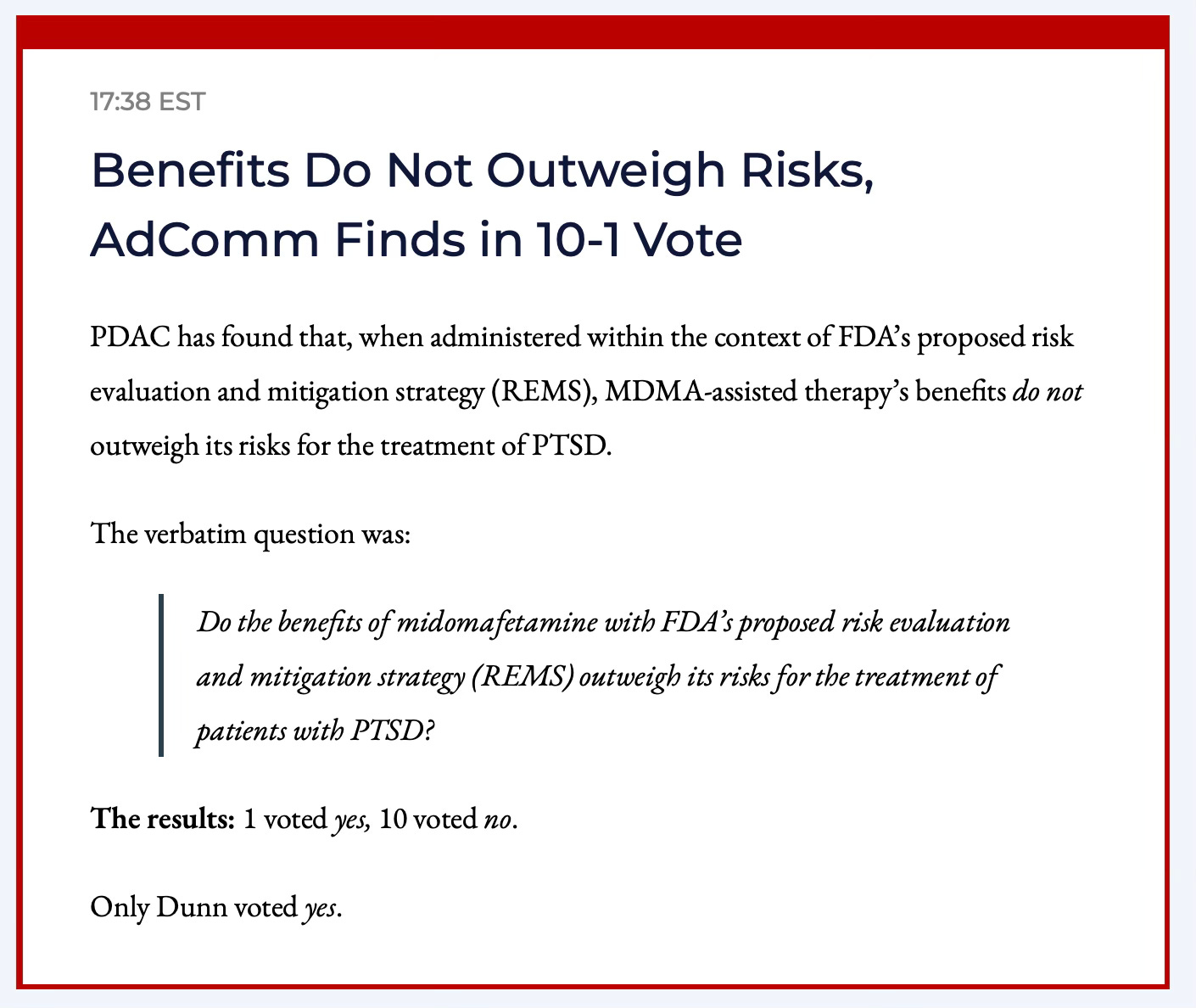
This series of articles? It is not intended as a hit piece. It is going to include reporting on what transpired yesterday, leading to two votes from the advisory committee against the approval of MDMA-AT as a treatment for Post-Traumatic Stress Disorder (PTSD).
I write this as someone with no vested interest in this specific modality being a “winner.” However, I do have a very keen interest in more effective treatments. I believe MDMA, Ibogaine, Psilocybin, and other psychedelic compounds will eventually deliver us from the purgatory of crappy treatments for PTSD. It is currently treated with standard-of-care treatments. Those treatments?
THEY DO NOT WORK WELL ENOUGH.
I’ve written about psychedelic medicines before:
How Big of A Deal Are Psychedelics Likely To Be?
Rick Doblin’s Advice About MDMA is Terrible
Psychedelic Medicines for Primary Care?
And many more…there is a search bar, people.
My interest is to end the suffering from PTSD. This is not just academic or professional interest. It is deeply personal. I have PTSD, myself. I don't have an allegiance to how that suffering is relieved. I care not one wit about which big personality is behind the solution.
I want to be well. I do not want to get treatment with underground illegal proxies for medical care. I hate the bullsh*t in medicine enough as it is; I don’t need crime as part of my healing journey. The delay in the approval of MDMA harms me personally. I’m sore about that. This series of articles will review:
What post-traumatic stress disorder is
What Lykos submitted to the FDA as a novel treatment
What the non-binding advisory committee heard and decided based on that
What a company such as Lykos could take as steps to address these concerns and get a novel treatment to market
Of course, AI will be mentioned as a possible solution to some of the above problems.
What is Post Traumatic Stress Disorder?
Let’s begin with why Post Traumatic Stress Disorder is so bad. If you think you might have PTSD, here is a free screening tool.
PTSD has four domains of symptoms (h/t Mayo Clinic)
A: Intrusive memories
Symptoms of intrusive memories may include:
Recurrent, unwanted, distressing memories of the traumatic event
Reliving the traumatic event as if it were happening again (flashbacks)
Upsetting dreams or nightmares about the traumatic event
Severe emotional distress or physical reactions to something that reminds you of the traumatic event
B: Avoidance
Symptoms of avoidance may include:
Trying to avoid thinking or talking about the traumatic event
Avoiding places, activities, or people that remind you of the traumatic event
C: Negative changes in thinking and mood
Symptoms of negative changes in thinking and mood may include:
Negative thoughts about yourself, other people, or the world
Hopelessness about the future
Memory problems, including not remembering important aspects of the traumatic event
Difficulty maintaining close relationships
Feeling detached from family and friends
Lack of interest in activities you once enjoyed
Difficulty experiencing positive emotions
Feeling emotionally numb
D: Changes in physical and emotional reactions
Symptoms of changes in physical and emotional reactions (also called arousal symptoms) may include:
Being easily startled or frightened
Always being on guard for danger
Self-destructive behavior, such as drinking too much or driving too fast
Trouble sleeping
Trouble concentrating
Irritability, angry outbursts, or aggressive behavior
Overwhelming guilt or shame
All of the above? It's not a great way for somebody to feel, and it's even less good for people interacting with that individual. PTSD is harmful to us all.
Submitted data
The FDA only rarely holds the hands of companies which are known as “Study Sponsors” in this process. They may have opinions about whether the treatment being submitted to them is a good idea, but they don’t share those opinions ahead of a submission. MDMA has what is known as “Breakthrough Status” which means that the FDA does a bit more hand-holding than usual which can speed up the process for treatments that have the potential to be substantially better than existing treatments for life threatening conditions, like PTSD. It also creates a binding paper trail about the decision making process. It can be very expensive to bring a drug to market, and it can be even more expensive to try to bring a complex drug market that isn't like other products if you submit a totally off track application and need to start over.
Just because the FDA accepts your New Drug Application for review does not mean they think it's a good idea, nor are they likely to approve it. I could submit this newsletter to the FDA and make the claim that it cured depression. That would be the label. That would be an extraordinary claim, and then I'd have to comply with whatever the FDA requested regarding safety and efficacy data to substantiate that claim.
When the FDA makes a suggestion in written communication to the study sponsor, it's not casual. They're not just stating an opinion about what they might like. This takes a little good sense. Subtlety. When it comes to human communication? Sometimes, people will say things that sound like a suggestion. But— it's not.
“Hey honey, do I look good in this dress?”
The answer is not, “You look awful; change right now. I don't like that dress; let’s have you dress like I wanted all along.”
The FDA is a lot like your life partner. It may sound like a suggestion or request, but it can be a nightmare if you don't comply (Quoting the FDA:)
Midomafetamine-assisted psychotherapy would be the treatment arm for the trial and “identical psychotherapy with inactive placebo” would be the control. However, the Agency cautioned that “although we continue to have concerns regarding the adequacy of the blind and any inadvertent bias this may introduce to the study, we agree with your proposed plan.”
MAPS PBC—now rebranded Lykos— was hell-bent on getting MDMA approved as a treatment combined with therapy. Not just any therapy, not a pre-existing therapy, a brand new manualized therapy. It's worth mentioning, and has been many times by the FDA, that they don't regulate therapy. Medical boards and professional societies in psychology, social work, etc, regulate therapy. When the agency cautions something and simultaneously says they agree with your proposed plan, it doesn't mean they think it's a good one. It means they think it's a bad plan, and they're not stopping you from doing it, but it's not a good idea. Take a hint. Please, God Study Sponsor, take a hint!
There is a precedent for prior pharmacological treatments designed to be administered with therapy. Generally, when you want to get a new thing through the FDA, it's a good idea to have it reference a previous thing they've already approved.
A combination product that has therapy on the label for the drug would include something like Suboxone:
‐‐‐INDICATIONS AND USAGE‐‐‐
SUBOXONE® sublingual film contains buprenorphine, a partial‐opioid agonist, and naloxone, an opioid antagonist, and is indicated for treatment of opioid dependence. (1)
SUBOXONE sublingual film should be used as part of a complete treatment plan that includes counseling and psychosocial support. (1)
That is it. That's all they needed to do. If they wanted to get MDMA—the drug alone, in combination with some psychotherapy, not a Franken-product that invented a new therapy along with a schedule one substance that has historically been understood to be a “love drug?”
It's not particularly difficult. Take a gold-standard treatment for post-traumatic stress disorder: specialized cognitive behavioral therapy called Prolonged Exposure, for example. Instead of having to create a brand new therapy manual written by a bunch of people who've had limited experience authoring therapy manuals, they could've just used an existing therapy with an existing manual.
Then, you give people the drug versus a comparator to see what's different. So, the claim that was submitted to the FDA was not this. The claim submitted was for a totally novel combination product, which they called MDMA-assisted therapy (MDMA-AT). They then studied MDMA-assisted therapy with a therapy manual. This was brand new and untested, and it's own adherence scale, which was also brand new and not meaningfully tested. They deployed this untested therapy along with MDMA in individuals with PTSD. They did two studies, ignoring the FDA advice about the designs of those studies, and the advisory committee yesterday opined—along with the public—on what they submitted.
No, I'm not just an asshole with an opinion. I'm a dude who has written a therapy manual—Adolescent Suicide and Self-Injury: Mentalizing Theory and Treatment. (amazon affiliate link).
Therapy manuals are written so that a specific therapy can be researched. Therapy is traditionally studied by capturing it on video and comparing what happens in the videos to what's written in the therapy manual, using an adherence scale. This does not mean that the therapy you're watching in the video is either good or bad. It just means it's the thing you thought it was. It's hard to study therapy if it's just any old thing. One of the problems with the proposed MDMA – AT protocol is that it's not much of a protocol. Let’s compare and contrast:
The MDMA-AT Manual—which let's keep in mind is written for people who are in theory already licensed therapists—advises a non-directive approach:
“Non-directive communication also uses invitation rather than direction. For example:
• “We encourage you to ...”
• “This might be a good time to ...”
• Use the gerund of a word: instead of “breathe” say “breathing” because it is suggestive rather that directive.
• Reflecting back to the participant what they are saying in order to continue conversation without being directive.
Gerunds recommended aside, the manual then goes on to get strangely spiritual and starts talking about inner healing intelligence, which is their prerogative, but it makes it hard for the FDA to know what to do about that:
Inner healing intelligence is a concept used throughout this manual to help put the participant in touch with their innate ability to heal and grow. The following analogies may help explain the concept:
—The body knows how to heal itself. If someone goes to the emergency room with a laceration, a doctor can remove obstacles to healing (e.g. remove foreign bodies, infection, etc.) and can help create favorable conditions for healing (e.g. sew the edges of the wound close together), but the doctor does not direct or cause the healing that ensues. The body initiates a remarkably complex and sophisticated healing process and always spontaneously attempts to move toward healing. The psyche too exhibits an innate healing intelligence and capacity.
—Seeds want to become a plant; it is the natural way.
—A tree always grows toward the sun; it is the tree’s natural inclination.
I get it. These are spiritual people and blah, blah blah. In an extremely quick search on the FDA website? It reveals that the words “inner healing intelligence” have never occurred in any FDA documentation for any drug in the agency’s history. The above manual would be the first time the FDA ever got anywhere near inner healing intelligence. And this is the opposite of traditional intelligence when you're asking them to accept many new things all at once. Even if you believe in inner healing intelligence, which is fine, you don't necessarily have to include it in your submission to the FDA.
It's a de novo concept. Maybe try starting with something that has a predicate. You know, like suboxone?
When you include a concept in a therapy manual at least 17 times, you must include it in the matching adherence manual in some way. This allows an independent rater to evaluate whether the treatment was provided in keeping with your therapy manual so that you know what you're evaluating in your study is what you think it is. There is an MDMA-AT manual, but it’s really thin on meaningful guidance as to how things should be rated as adherent beyond samples and yes/no checkboxes. Notably, there is nothing to score about guiding participants in their quest for inner healing intelligence:
6b. Therapists conveyed a non-judgmental attitude toward the participant’s experience and did not pathologize transpersonal experiences or multiplicity, if they occurred.
—Therapists should be observed overall to convey non-judgment toward the participant’s experience.
—If the participant experiences transpersonal experiences or multiplicity, the therapists should convey a respect for and openness toward the participant’s experience and view.
Examples:
Yes: The therapist says, “Try to see what direction the medicine gives you. Instead of trying to control your thoughts, trust the medicine will unravel these knots in some way and take on direction. As much as you can, let go of worrying about how you are going to heal. Breathe into the process and trust your own inner healing intelligence with the help of the medicine.”
No: The therapists suggest repeatedly that the participant use art to try to express herself; the participant agrees the first time, and then says no three times.
No: The therapists leave the participant in inward focus for long periods of time (2 hours, 1.5 hours) without checking in; then, in periods of communication, they are over-directive in their questions and lead the participant to specific topics.
As for our friend “inner healing intelligence,” much like on the FDA site, it appears only minimally in the MDMA-AT adherence manual, mentioned only once, on page 17:
Examples and feedback about the tenor of participants’ interaction with the therapists
1:18:00 (While attempting to stay clear of being "parental") T2 reiterates concerns about the client's safety. P appears to take this somewhat defensively (kind of underscoring a level of transference or judgment about herself). I am concerned with how these therapists kind of freeze up or shut down in response to the client's somewhat unusual lifestyle. I worry that their judgment over her lifestyle will become much more evident to the client during the experimental session which could get in the way of the client fully embracing her true self and accessing her inner healing intelligence.
I'm not trying to be difficult, but if inner healing intelligence was a crucial part of MDMA-assisted therapy warranting over 17 mentions in the training manual, it should appear in the adherence manual as more than a passing mention.
This is not a serious therapy manual, nor a serious therapy adherence manual, and the FDA doesn't regulate therapy. It will not be particularly attuned to that issue, but I'm here to tell you— it's a fact. This is not a good therapy manual and an even worse adherence manual. None of these concerns means that I take issue with the concept that MDMA is a catalyst for therapy to heal trauma, which may be true. Still, I think starting with an existing therapy that has an existing validated rating scale would've been a vastly superior approach.
It's also a profoundly biased adherence manual if it is also to be given as therapy to a placebo group because it encourages therapists to spend a lot of time talking about the medicine. If it's about the therapy, you probably shouldn't spend so much time talking about what the medicine is doing, or you're gonna have a really hard time in the placebo group, which is what they saw in the study. You're going to have rolling of one’s eyes—not meaningful change—and so one would bias the study towards a positive result for the drug group if the placebo group talks about the drug that does nothing the whole time. It’s not just functional unblinding—it’s biasing the data towards a lack of response in the placebo group, which could have been addressed per the FDA's repeated requests but, perplexingly, wasn’t acted on affirmatively by the study sponsor.
Per the FDA communication to Lykos:
Along with bias from functional unblinding, there may also be expectation bias in which those who believed that they received active treatment expected that they would experience a clinical benefit, those who received placebo fared worse due to disappointment when they did not experience anticipated effects from them treatment, or some combination of both. In addition, it is likely that the in-session monitors could deduce a participant’s treatment assignment based on that participant’s behavior during the session. Thus, both the participant and the study staff were likely aware to which treatment arm a given participant was assigned. It is reasonable to assume that functional unblinding and expectation bias has impacted treatment effects observed in the clinical trials with MDMA to some extent.
After the FDA made it relentlessly clear that they should have some sort of active agent as the placebo that could create a sensory experience so that they have some hope of preserving the blind, and this concern was completely ignored, they went on to study their combined treatment. I will briefly pause from hating on this to document what a real adherence manual looks like: I will compare this to a therapy adherence manual I'm very familiar with, which is for mentalization-based treatment. I'm not choosing this willy-nilly because I think it would be a great therapy manual for combination with a compound like MDMA, in that it would meaningfully address the issues with borderline personality disorder that were coming up in the trial, as well as having a structure to address trauma. I'm doing it for the same reason MAPS PBC/Lykos should've taken a similar tact: I am already familiar with it. That is a predicate—and in FDA land, that is clutch. Back to therapy adherence manuals for predicate purposes:
Mentalization-based treatment has a validated adherence scale—The MBT-ACS:
The properties of the 17-item Mentalization-Based Treatment Adherence and Competence Scale (MBT-ACS) were investigated in a reliability study in which 18 psychotherapy sessions, comprising two sessions by nine different therapists, were rated by seven different raters. The overall reliabilities for adherence and competence for seven raters were high, .84 and .88 respectively. The level of reliability declined by number of raters but was still acceptable for two raters (.60 and .68). …
So I think that's normal did you research whether the adherence scale is valid and has high interrater reliability? You don't just develop a therapy manual and not evaluate whether the therapy is reliably measurable. Except if you're MAPS/Lykos, they did exactly that.
Here is what the MBT Adherence scale for each session looks like, which has established validity as above:


And yes, Dorothy, there is a very complex manual to train raters to develop a system that reliably uses such a complex tool. Here is a brief sample of how specific adherence manual is about how things are rated:
Skill level is not the same as effectiveness of intervention. A clinician may make an intervention at a high level of skill but with little effect.
If a clinician engages in interventions with sufficient frequency or extensiveness to rate the domain but the rater thinks more of the items/interventions should have been used, this is rated here.
The rater:
a) Notes the failure to deliver a range of items/interventions when working in a domain. Should more of the items appropriate to the domain have been used?
b) Notes the failure to appropriately stop delivering interventions, for example, due to increasing arousal because of the intervention.
b) Considers that an item/intervention could have been used more.
c) Decides whether how the interventions were delivered was neutral, negative or positive.The HOW delivery of interventions/items is scored as follows:
+1.0 The intervention is used at a level to maintain clinical interaction and therapeutic alliance. Context and content are respected in terms of responding to the patient. Timing is appropriate. Multiple items used flexibly within the domain. Avoidance if necessary of interventions leading to excessive anxiety.
OR Uses active avoidance of intervention – for example, when the patient is manifestly within relational mentalizing process but, because of high emotional intensity, this work is reduced (‘Perhaps this is not the time for us to go into that.’ The clinician then moves the conversation to reduce anxiety).
+0.5 Timing is appropriate and context respected but hesitant delivery.
That looks like WORK. A brief comparison to the MAPS manual will, again, be instructive:
Yes/no questions do not a serious therapy adherence manual make. Now, on one hand, you can forgive the FDA for not knowing what to do with this because this is just not the kind of thing they're familiar with. They don't evaluate therapy manuals. They evaluate drugs and devices.
They haven't been said; Lykos didn't submit data on cardiac changes from EKG studies as requested (From the FDA):
A thorough QT study would be conducted prior to submission of the NDA, but not prior to the start of the phase 3 trial. (THIS DID NOT HAPPEN)
This would've been standard for any amphetamine-related compound, and they didn't submit lab values because they didn't draw them on their study patients to evaluate what's happening in the livers and kidneys of individuals who took their drug. These items are absolutely within the purview of the FDA, and it turns out, according to their own admission, they just forgot to ask for those details because somebody missed the fact that the standard things that happened with any drug submission didn't happen.
Of course, there were some other extraordinary “non-standard” events in this trial of a non-standard drug, which we will discuss tomorrow. And don’t worry, by the end of this series I will lay out a path forward following this traumatic hearing. I cannot promise I will be using my inner healing intelligence as we go on this journey, nor can I promise a non-directive experience. I don’t think you came here for that, nor did the FDA.


This is a chef’s kiss analysis
"This is why we can't have nice things."